
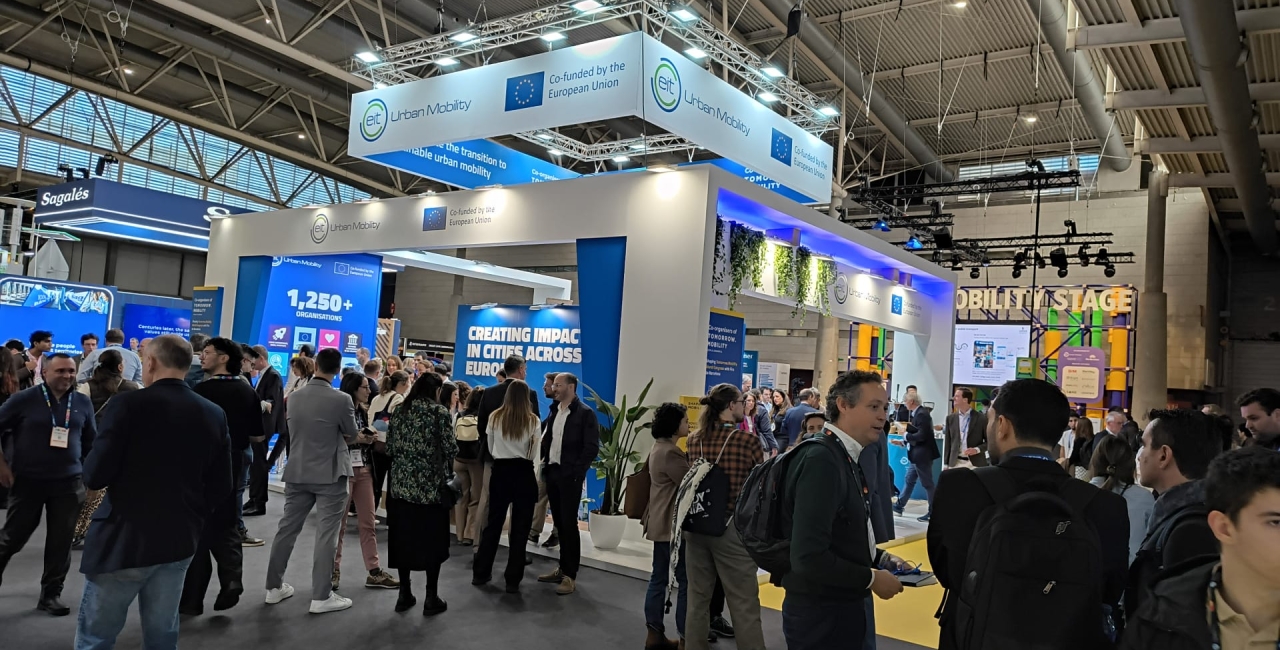
Barcelona, 4 November 2026 – What will European cities look like in the coming years, and who will finance their transformation? These were among the key questions shaping discussions on the second day of Tomorrow.Mobility World Congress and Smart City Expo World Congress.
One of the day's most significant discussions brought together representatives of the Spanish Government, the European Commission and EIT Urban Mobility.
Teresa Riesgo Alcaide, Secretary General for Innovation in the Spanish Government, Stefaan Hermans, Director at the European Commission, Marc Rozendal, CEO of EIT Urban Mobility and President of Tomorrow.Mobility World Congress, and Pierre Olivier, Deputy Mayor of Lyon's 2nd arrondissement and Vice-President of Métropole de Lyon, took part in a discussion on the future of mobility and the role of innovation in urban development.
Beyond European strategies and policy objectives, the discussion highlighted a practical challenge: how can local authorities turn innovative projects into services that genuinely meet citizens' needs?
Another important topic was the use of artificial intelligence in local government. Representatives from Fort Worth, Heidelberg and Albuquerque shared perspectives on how emerging technologies can help cities address increasingly complex urban challenges.
The connection between urban mobility and public health was explored in a session bringing together researchers from the University of Tartu and Ghent University. The central message was that urban transport should be assessed not only in terms of infrastructure and efficiency, but also through its impact on people's health and quality of life.
The day's programme also featured discussions on financing urban innovation through public-private partnerships, as well as the development of affordable housing, an increasingly pressing challenge for major European cities.
For Romania, many of these issues are already part of everyday reality. Public transport, traffic congestion, the digitalisation of local government and the need to attract investment require more than funding. They demand well-prepared projects, effective cooperation and long-term commitment.
InfoMediu Europa is reporting from Barcelona, at the invitation of EIT Urban Mobility, following the debates, technologies and European initiatives that could provide valuable examples for Romanian cities, public authorities and businesses.
One conclusion stands out from the second day: cities do not become smarter simply by adopting new technologies. They become smarter when those technologies make people's lives better.
#TomorrowMobility #SmartCityExpo2026 #InfoMediuEuropa #EITUrbanMobility #SmartCities #UrbanMobility